How does a vacuum - insulated travel cup work?
Leave a message

Vacuum-insulated travel cups have become an essential accessory for many people on the go. Whether you're commuting to work, traveling, or simply enjoying a day out, these cups help keep your beverages at the desired temperature for extended periods. As a travel cup supplier, I've had the opportunity to learn a great deal about how these innovative products work. In this blog post, I'll delve into the science behind vacuum-insulated travel cups and explain why they are so effective.
The Basics of Heat Transfer
To understand how a vacuum-insulated travel cup works, it's important to first grasp the basics of heat transfer. There are three main ways that heat can move from one place to another: conduction, convection, and radiation.
Conduction is the transfer of heat through direct contact between two objects. For example, when you touch a hot stove, heat is conducted from the stove to your hand. In the context of a travel cup, conduction would occur if the hot liquid inside the cup transferred heat directly to the outer surface of the cup, which would then transfer heat to your hand or the surrounding environment.
Convection involves the transfer of heat through the movement of fluids, such as liquids or gases. When a fluid is heated, it becomes less dense and rises, while cooler fluid sinks to take its place. This creates a circular motion that transfers heat. In a travel cup, convection could occur if the hot air or liquid inside the cup rises and transfers heat to the top of the cup, which could then escape into the environment.
Radiation is the transfer of heat through electromagnetic waves. All objects emit and absorb radiation, and the amount of radiation emitted depends on the temperature of the object. In a travel cup, radiation could occur if the hot liquid inside the cup emits infrared radiation, which could then be absorbed by the outer surface of the cup and transferred to the environment.
How Vacuum Insulation Works
The key to a vacuum-insulated travel cup's effectiveness lies in its ability to minimize all three types of heat transfer. This is achieved through the use of a double-walled construction with a vacuum layer in between.
The inner and outer walls of the cup are typically made of stainless steel, which is a good conductor of heat but also has a relatively low emissivity, meaning it doesn't emit or absorb radiation very well. The vacuum layer between the two walls is essentially a space with very low pressure, which means there are very few air molecules present. Since air is a good conductor of heat, removing most of the air from the space between the walls significantly reduces conduction.
Without air molecules to transfer heat through convection, the movement of hot air or liquid inside the cup is also minimized. This helps prevent heat from rising and escaping through the top of the cup.
In addition to reducing conduction and convection, the vacuum layer also helps minimize radiation. Since there are very few air molecules in the vacuum, there is less material to absorb and emit radiation. This helps keep the heat inside the cup and prevents it from being transferred to the outer surface of the cup and the surrounding environment.
Additional Features for Enhanced Insulation
In addition to the vacuum layer, many vacuum-insulated travel cups also feature additional design elements and materials to further enhance their insulation properties.
One common feature is a tight-fitting lid. A well-designed lid helps prevent heat from escaping through the top of the cup by creating a seal that minimizes air exchange. Some lids are also insulated, which helps further reduce heat transfer.
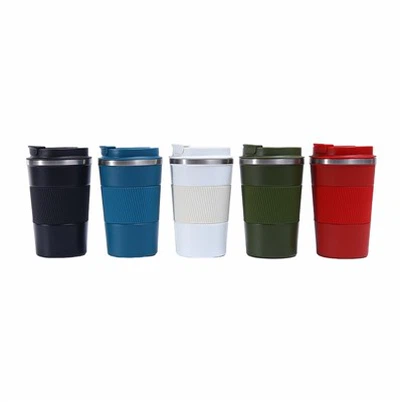
Another feature is the use of a powder-coated finish on the outer surface of the cup. Powder coating not only gives the cup a stylish appearance but also provides an additional layer of insulation. The powder coating acts as a barrier that helps prevent heat from being transferred from the cup to your hand or the surrounding environment. Check out our Powder Coated Travel Mug for a great example of this feature.
Some travel cups also have a reflective coating on the inner wall. This reflective coating helps reflect infrared radiation back into the cup, further reducing heat loss through radiation.
Testing and Performance
To ensure that our travel cups meet the highest standards of insulation performance, we conduct rigorous testing using industry-standard methods. We measure the temperature of the liquid inside the cup at regular intervals over a period of time to determine how well the cup retains heat.
Our Stainless Steel Travel Mug 16 Oz has been tested to keep hot beverages hot for up to 12 hours and cold beverages cold for up to 24 hours. These results are based on ideal conditions, but in real-world use, the performance may vary depending on factors such as the initial temperature of the beverage, the ambient temperature, and how often the cup is opened.
Why Choose Our Travel Cups
As a travel cup supplier, we are committed to providing high-quality products that meet the needs of our customers. Our vacuum-insulated travel cups are designed with the latest technology and materials to ensure maximum insulation performance.
In addition to their excellent insulation properties, our cups are also durable and easy to clean. The stainless steel construction is resistant to corrosion and rust, and the powder-coated finish is scratch-resistant. Our cups are also dishwasher-safe, making them convenient for everyday use.
We offer a wide range of styles and sizes to choose from, so you can find the perfect cup to suit your needs. Whether you're looking for a small cup for your daily commute or a larger cup for a long trip, we have you covered.
Contact Us for Purchasing
If you're interested in purchasing our travel cups for your business or personal use, we'd love to hear from you. Our team of experts is available to answer any questions you may have and help you find the right products for your needs. Contact us today to start a conversation about your purchasing requirements.

References
- "Thermal Insulation: Principles and Practice" by Arun K. Datta
- "Heat Transfer" by Frank P. Incropera and David P. DeWitt
- "Engineering Thermodynamics" by Yunus A. Cengel and Michael A. Boles